The River Wolf
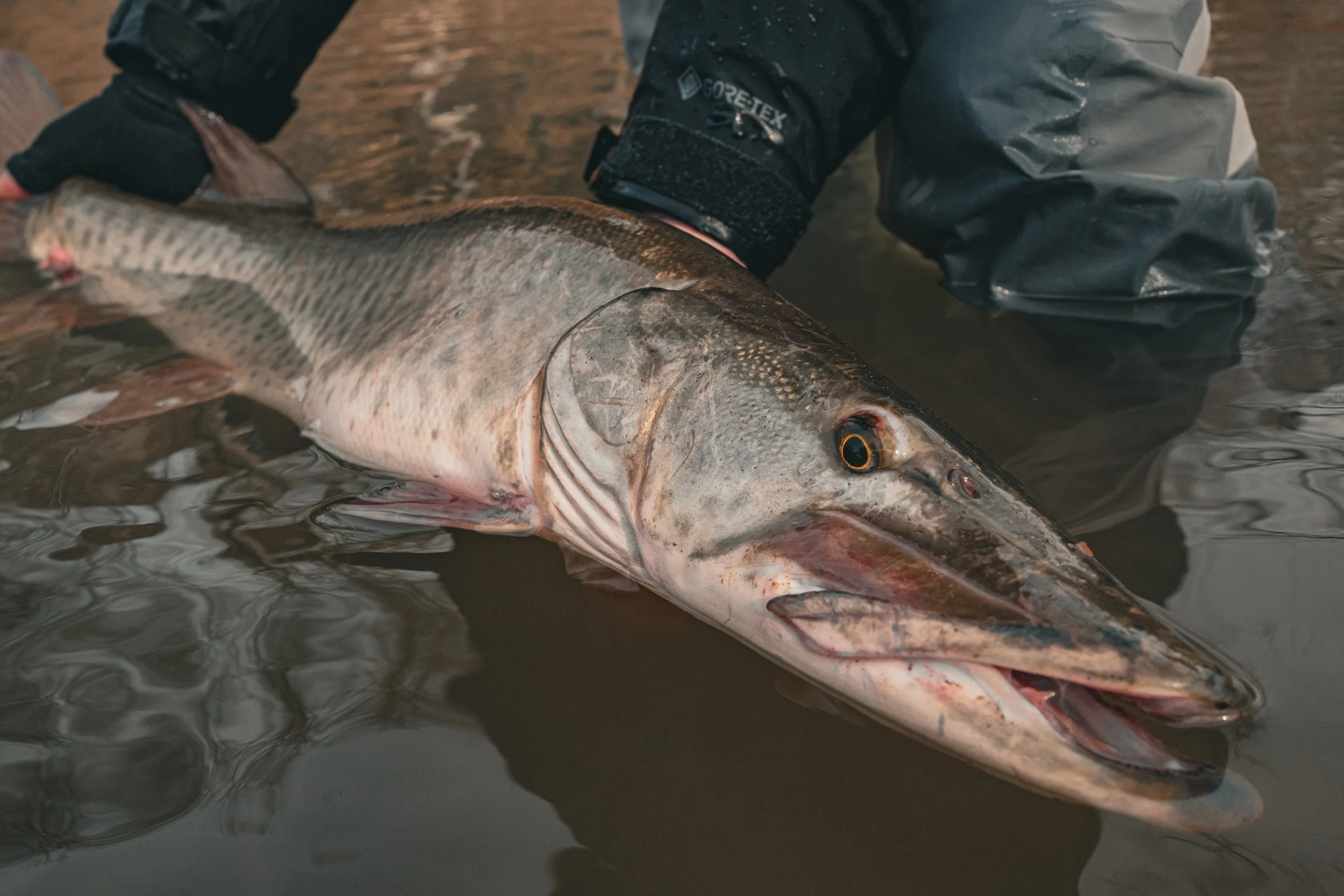
If I could describe musky fishing in a single phrase it would be something like, “Just when you have convinced yourself that they don't exist. They show themselves by but a brief glimmer. But only AFTER you have sworn to God they are no different than the dragons you read about as a kid. A story told by fishermen to excite the ill-informed. And if you are graced with seeing one. You won't catch one until you have convinced yourself you never will.
As a fly fisherman who pursues these olive ghosts, I wish I could describe it to you in a more romantic way. But there is nothing romantic about the abusive nature of Musky fishing. Even more so on the Fly.
You wake up at 3 a.m. so that you can be at the boat ramp at sunrise just to spend all day throwing out your shoulder with 12-inch flies just for the musky to deny or miss your fly and eat your buddies. That's life for you, And I drove home happy.
If that sounds insane, it is. But here's what most people don't understand: that fish is probably older than my marriage. Maybe older than my truck. A forty-inch female in a river system could easily be pushing fifteen years. Get up to fifty inches and you're talking about a fish that's been swimming those same holes since before some of you reading this had kids.
(Indiana DNR reports females typically reach 44 inches by age 12 and can live beyond 20 years: https://www.in.gov/dnr/fish-and-wildlife/fishing/muskie-fishing/)
The Ohio muskellunge is native to Kentucky. Native to West Virginia, to the upper Tennessee drainage, to the rivers that cut through the Cumberland Plateau. When we talk about muskies in Appalachia, we're not talking about some imported sportfish dropped into a reservoir to give weekend warriors something to chase. We're talking about an apex predator that evolved to patrol these waters. These fish have been here since before there was anyone around to name the rivers they lived in.
(Kentucky Department of Fish & Wildlife confirms native range includes Green, Kentucky, Licking, and Little Sandy river drainages: https://fw.ky.gov/Fish/Pages/Muskellunge.aspx)
And we almost lost them.
Pollution did most of the damage. Siltation from coal operations, agricultural runoff, dams that choked off spawning migrations. By the mid-twentieth century, Kentucky's native muskie populations were hanging on by a thread. A vigorous hatchery program at Minor Clark brought them back from the edge. Every muskie stocked in Kentucky today comes from that facility, raised from broodstock captured in state waters, all descended from the Ohio strain that somehow survived the worst of what we threw at them.
But here's what bothers me.
People treat these fish like they're renewable. Like they're bass that'll spawn twice a year and flood the system with new recruits. That's not how muskies work. Not even close.
A female muskellunge might not reach sexual maturity until she's six to eight years old. She'll spawn once a year if conditions are right. And conditions are almost never right. The eggs need specific water temperatures. They need flooded vegetation, access to backwater areas, stable flows during incubation. One bad flood during the spawn and an entire year class disappears. One cold snap. One drought that drops the water level six inches at the wrong moment.
Wisconsin's been studying this for decades. Only about eighteen percent of their muskie populations are considered self-sustaining. The rest require stocking to maintain any kind of fishable numbers.
(Wisconsin DNR muskie management update documents declining natural reproduction: https://dnr.wisconsin.gov/sites/default/files/topic/Fishing/Musky_Muskyupdate_2012.pdf)
In Green Bay, researchers have been radio-tagging adults and tracking them to spawning sites for years. They've collected hundreds of egg samples. Want to know how many larvae they've captured? Two. Total.
(USGS-published study on Green Bay spawning habitat, 2025: https://pubs.usgs.gov/publication/70273057)
That's not a typo. They found two baby muskies in three years of intensive sampling.
The eggs get eaten. They suffocate in silty substrates. The dissolved oxygen drops too low in degraded tributaries. The fry that do hatch face predation from everything including their own siblings. The journey from fertilized egg to adult muskie is something like being shot out of a cannon at a brick wall while blindfolded. Most don't make it.
Which brings us back to that forty-inch fish I watched follow my fly and refuse to eat.
Think about everything that fish survived to reach that size. A decade of floods. A decade of droughts. The annual gauntlet of anglers like me throwing meat at her face. Other predators. Temperature swings. Low water summers when the creek mouths she needed for thermal refuge almost dried up. Disease outbreaks like the VHS virus that hammered St. Lawrence populations so hard they still haven't recovered.
(New York DEC documents ongoing VHS impacts on St. Lawrence muskie populations: https://dec.ny.gov/things-to-do/freshwater-fishing/fisheries-management-research/muskellunge-management)
And she's still swimming.
Now think about what happens if I had hooked her in July when the water temperature was pushing 80 degrees. Research out of West Virginia University tracked muskies caught and released during warm-water periods. In controlled pond studies, mortality hit forty-three percent for fish caught when temperatures exceeded 77 degrees. That's not theoretical. That's nearly half the fish dying after being released by anglers who thought they were doing the right thing.
The Potomac River study painted an even uglier picture. Tagged muskies that were caught during summer heat waves showed a forty-eight percent mortality rate. These were fish handled properly, released quickly, photographed for minimum time. They still died.
Blood chemistry research explains why. When water temperature climbs, a muskie's hemoglobin literally can't pick up enough oxygen even when oxygen is present in the water. Add the physical exertion of fighting a line, the stress of being netted, the lactic acid flooding their system, and you've got a fish that looks fine when it swims away but sinks to the bottom dead three days later.
The answer isn't to stop fishing.
It's to fish smarter. Bring gear that can actually handle these animals. An under-gunned angler who fights a muskie for twenty minutes on light tackle is essentially executing it. Heavy rods. Stout leaders. Rubber-bag nets if you can afford it. Keep the fish in the water. Support the belly. Act accordingly.
And when the water gets hot, consider staying home.
Fly fishing for muskies has gotten popular enough that you can buy purpose-built 10&11- weight rods and specialized sinking lines for the pursuit. Drift boats that used to be purely western trout icons are showing up on Appalachian rivers chasing the same fish. There's something about catching a muskie on a fly that I can't quite articulate. Maybe it's the proximity. You're so close. That follow happens at six feet instead of sixty. You see the eye. You watch the fins flare. When they refuse, you can almost convince yourself you understand why.
But this new wave of muskie fly anglers carries responsibility with it. The catch-and-release ethic that came east with the drift boat culture needs to include the uncomfortable conversations. About temperature. About gear. About the days when the ethical choice is to rig up for smallmouth instead.
Because here's the truth nobody wants to say out loud: a big female muskie might contribute more to the next generation of fish than ten smaller males combined. Lose her, and you're not just losing one fish. You're losing the eggs she would have scattered over the next fifteen years of spawning. Hundreds of thousands of eggs. The math is brutal.
When I think about why I fish for muskies, I keep coming back to the rivers themselves. These waters are cleaner now than they were fifty years ago, but they're still under siege. Agricultural runoff. Sedimentation. Dam operations that alter natural flows. Every threat to muskie habitat is a threat to everything else that swims there. Smallmouth. Spotted bass. The aquatic insects that sustain entire food webs.
You can't separate the fish from the water.
My first musky is a feeling ill never forget.
I've spent countless hours and thousands of casts to replicate that feeling. What I know for certain is this: HOW we fish for them right now determines whether my kid ever gets to see one.