Mud, Muskies, and a Raft That Was Trying to Kill Us
Nobody catches muskies.
That's not entirely true, but it's close enough to feel true after your fourth consecutive blanked day on the water. They call it "the fish of ten thousand casts" and whoever coined that phrase was either being optimistic or had never actually tried to catch one on a fly rod, because ten thousand starts to feel quaint real quick.
There's something genuinely unhinged about fly fishing for musky. Regular musky guys, the conventional crowd with their big baitcasters and their bulldawgs, they at least get to cover water fast. They get to make fifty casts in the time it takes you to false cast, load up, and heave something the size of a small mammal sixty feet across a current seam. You're throwing flies that weigh as much as a decent sandwich. Flies that catch air like a kite and try to bury a 6/0 hook in your ear on every backcast. Flies that take two hours to tie and look absolutely insane, bucktail and flash and rubber legs going every direction, like something that crawled out of a biology textbook and made bad choices.
And the fish. God, the fish. A musky will follow your fly all the way to the boat, pull up six inches from your rod tip, look you directly in the soul, and then simply leave. No eat. No commitment. Just a slow, contemptuous turn and gone. They do this on purpose. I'm convinced. There's an intelligence behind those eyes that borders on personal.
On the fly, you've stripped away every mechanical advantage you had. You're down to raw presentation, raw retrieve, raw stubbornness.
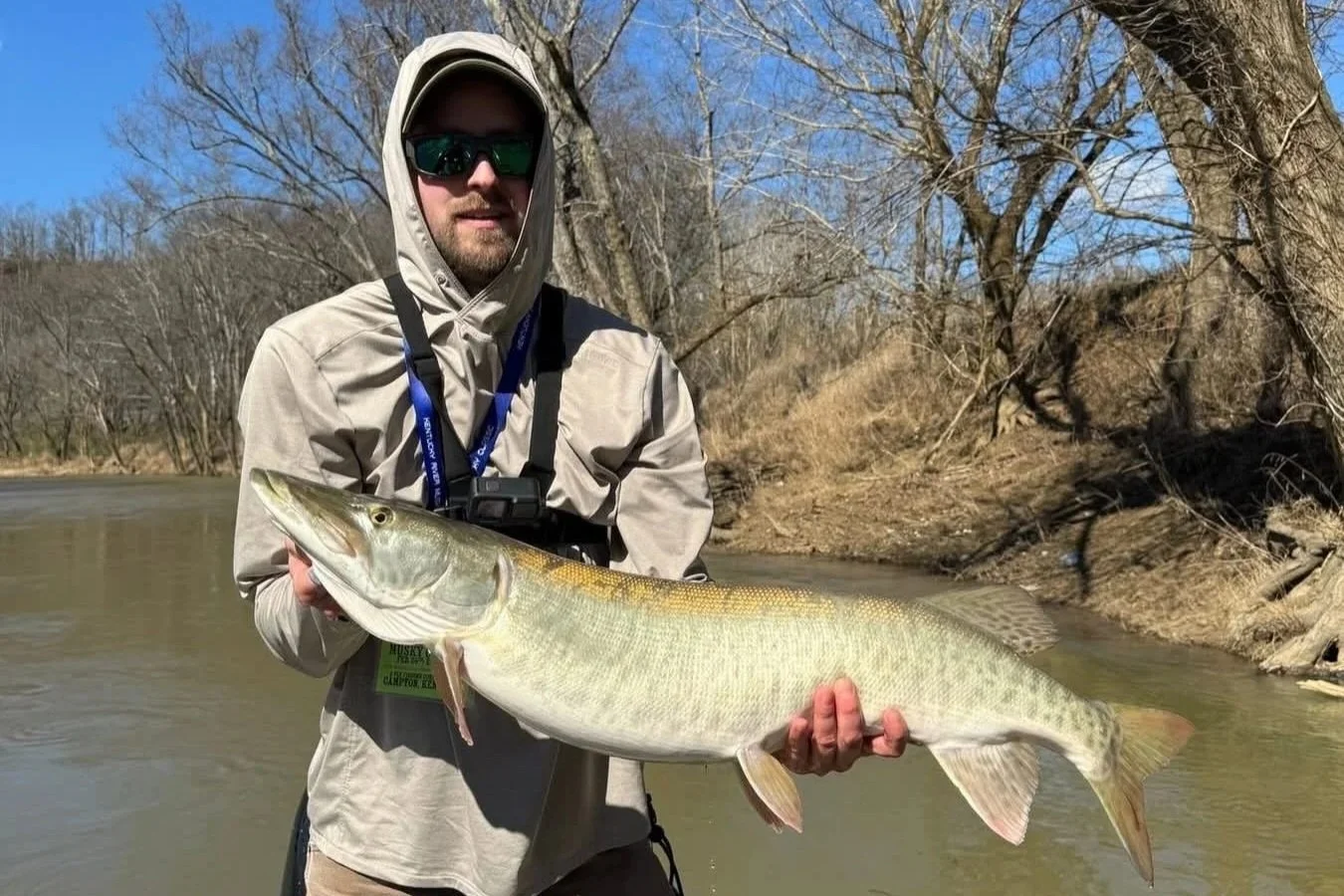
Kentucky is quietly one of the best places in the country to lose your mind over this fish. The river system holds muskies that have eaten well and grown long in cold water and couldn't care less that you exist. The Kentucky River Musky Classic is built around that specific brand of masochism. Fly only. Catch and release. Measured on length. No live wells, no meat, no bass boat energy. Just a collection of people who got bit by something they can't name and can't quit and don't particularly want to.
The Kentucky River is a liar.
Friday she was a godsend. That perfect green-gray clarity, stained just enough to hide your mistakes but clear enough to watch a forty-inch shadow track your fly out of the timber. Current sliding around the limestone ledges like it belonged there. You could see structure. Pockets. The inside seams where big fish park and wait. We were confident. Cocky, even. Standing around at takeout talking the way anglers talk when the water looks right and the tournament hasn't started yet and everything still feels possible.
Tomorrow might be stupid good.
Then the rain came.
Not a sprinkle. Not a passing shower you wave off with a beer in your hand. A full-throated, sky-opening Kentucky deluge that rolled through overnight and didn't turn the river to mud, but it didn't need to. What it did was meaner than that. It just got fast. Pushy and stained, the color of weak tea with a bad attitude, running hard enough that every mental bookmark you'd made the day before needed to be thrown out and rethought from scratch.
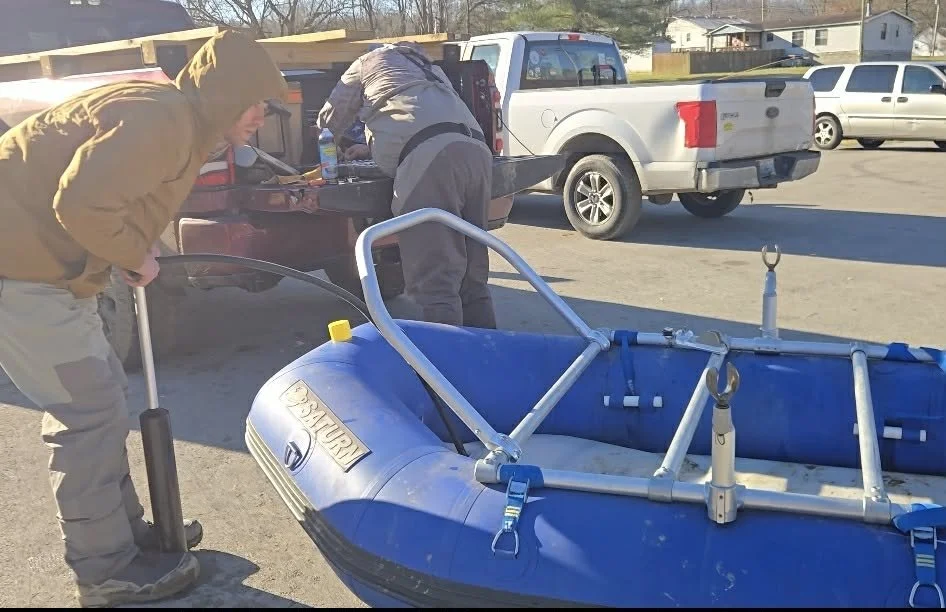
Besides that, our raft was dying.
Not dramatically. Quietly. The floor valve had a slow leak, a death rattle that started at the boat ramp and never quit. By noon we weren't sitting on the floor anymore. We were squatting on the tubes like gargoyles while our boots sat in six inches of frigid Kentucky runoff. You ever try to double-haul a ten-weight while your footing is essentially a wet marshmallow? It's a circus act. The fly line kept sinking into the deflating floor, snagging on every D-ring during the backcast, the whole raft shaking and sighing underneath us while we kept asking each other the only question that made any sense: why would we do this to ourselves?
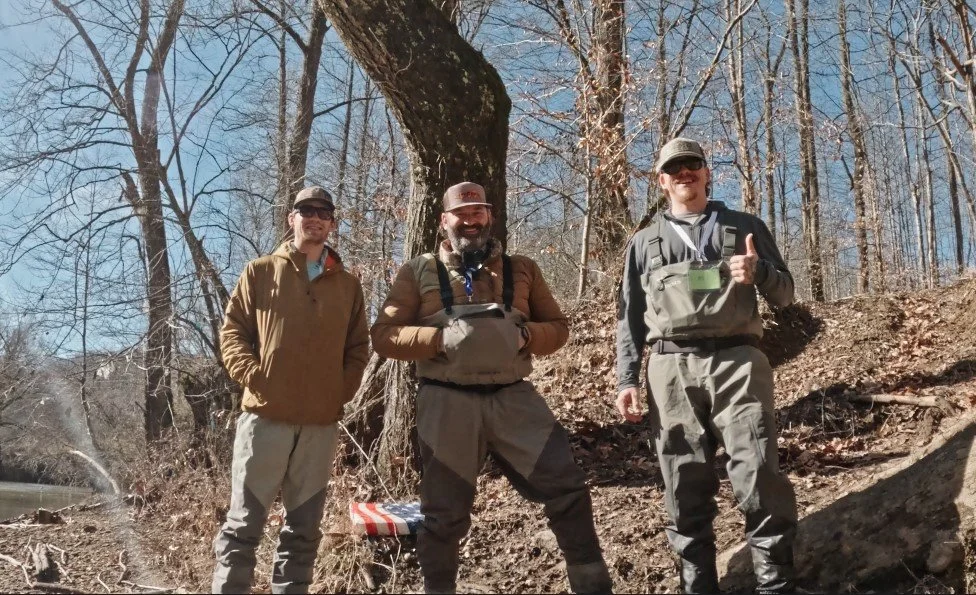
Three grown men. A ten-foot raft that was actively giving up on life. Pushy, stained water in every direction.
What do you do? You keep fishing. You're in the Kentucky Musky Classic. You don't trailer out because your raft is having an existential crisis and doing its best to give you one.
Throwing a big articulated fly on my Whuff Rod Co. 11wt, bombing casts into inside seams and current breaks, anywhere I thought a fish might be stacking up to get out of the push. Cast. Strip. Feel nothing. Cast again. Your fly disappears the moment it enters the water and you're just counting strips and hoping something intercepts it in the dark. Fishing on faith. Pure, stupid, irrational faith.
By the end of the first day, three launches, miles of river, shoulders that were filing formal complaints, we had nothing. Not a touch. Not a follow. We were beat.
Then one came.
Like a ghost she materialized behind my fly and tracked it all the way to the raft. I saw her. My heart rate doubled in about half a second. And then, just as fast as she appeared, she turned. No eat. Just hope, slipping away through the current. I stood there trying to get my brain to catch up to my chest, running through every possible thing I'd done wrong.
We worked that fish. Tried every angle, every retrieve. Threw everything we had at her.
Nothing.
About twenty yards downstream, pulling toward takeout, both me and my partner Hunter Smith threw into the same hole at the same time. A massive shape flashed maybe ten feet from the raft. Dave, our man on the oars, said it before either of us could process it.
"Somebody just got ate."
I went to strip set and all my left hand felt was weight. Heavy, violent, unreasonable weight. The kind that shoots straight up your arm and into your sternum.
"I got one."
The fish rolled once in the current and my brain took a full second to register what I was looking at. Big. Actually big. The kind of size you don't want to say out loud because saying it out loud feels like tempting something. Dave was already fighting the net, passing it to Hunter, and when he finally got eyes on her he just said, quietly, "That's a big fish, boys."
It wasn't until she was in the net that the full scale of it hit us.
If you were within five miles of us you heard me scream. If you were within ten you probably felt it. Three guys standing in a sinking raft, laughing like lunatics, holding a fish that had just justified every miserable cast, every pumped-up floor, every rain-soaked, blown-out, faith-based decision we'd made all weekend.
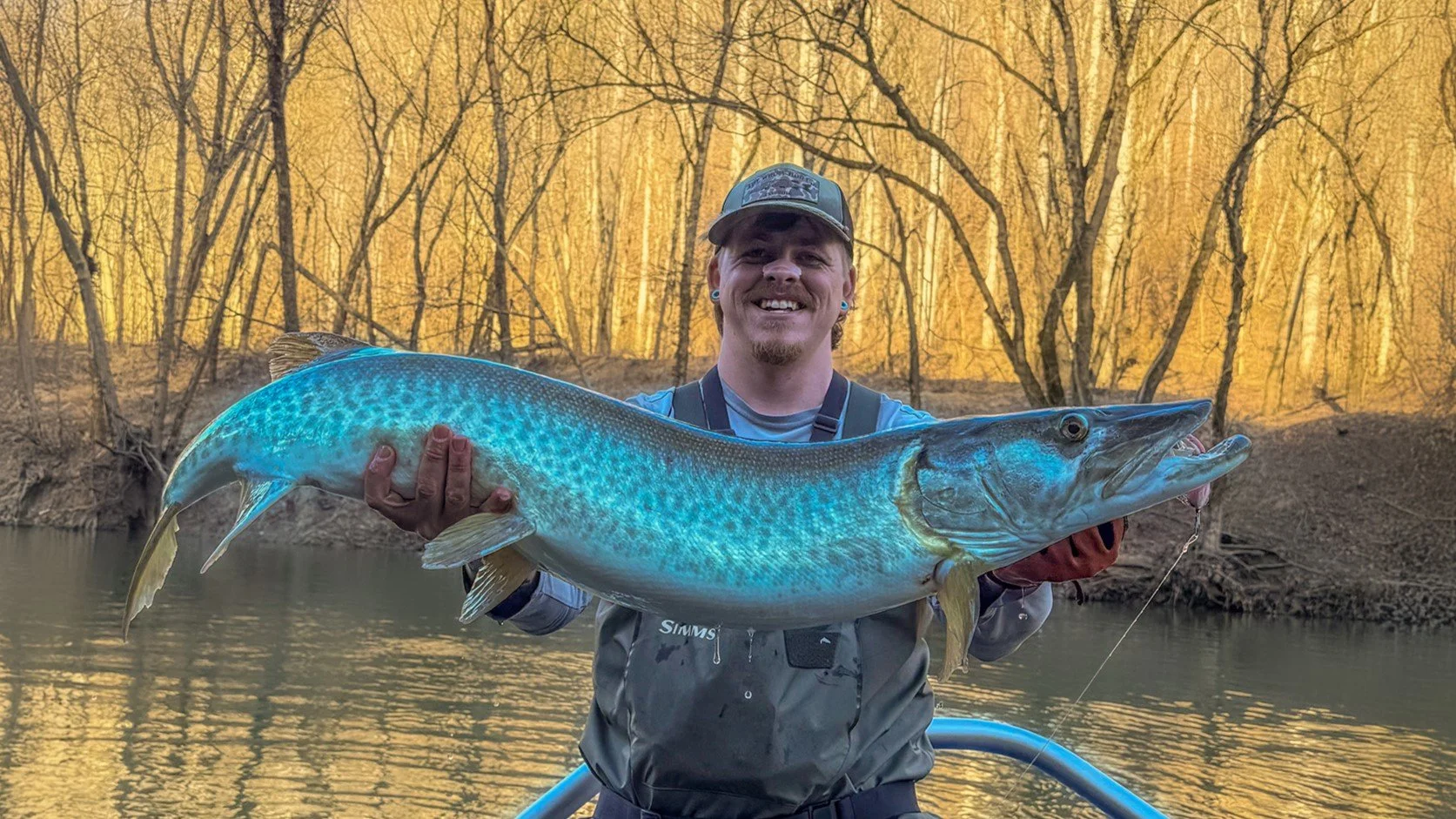
She was a tank. Heavy-shouldered, scarred up, prehistoric. Her eyes had that cold, flat stare that tells you exactly how long she'd been in this river and exactly how little she thought of us. Forty-six and a half inches. Biggest fish of the tournament. Our only fish of the tournament.
Here's the thing I keep coming back to.
Musky fishing on the fly isn't growing because it's easy or comfortable or because the odds are good. It's growing because people are hungry for something that doesn't hand them anything. We've optimized almost everything else, the gear, the forecasts, the fish finders, the algorithms telling you where to be and when. Musky on the fly is a hard no to all of that. It strips the whole enterprise back down to the cast and the strip and the ten-thousand-to-one shot that something ancient and enormous decides, for reasons entirely its own, to eat.
Kentucky's musky culture is built on that. It's guides and tiers and dirtbag anglers and weekend warriors who all share the same quiet obsession, all drawn to the same rivers, all throwing the same ridiculous flies into the same cold water. The Classic exists because this community needed a reason to gather around something they already couldn't explain to the people in their lives who didn't get it.
A sinking raft. A blown-out river. One fish in two days.
And not a single person on that water would trade the weekend.
That's the whole point.