The Case for "Tennis Shoes" in Elk Country
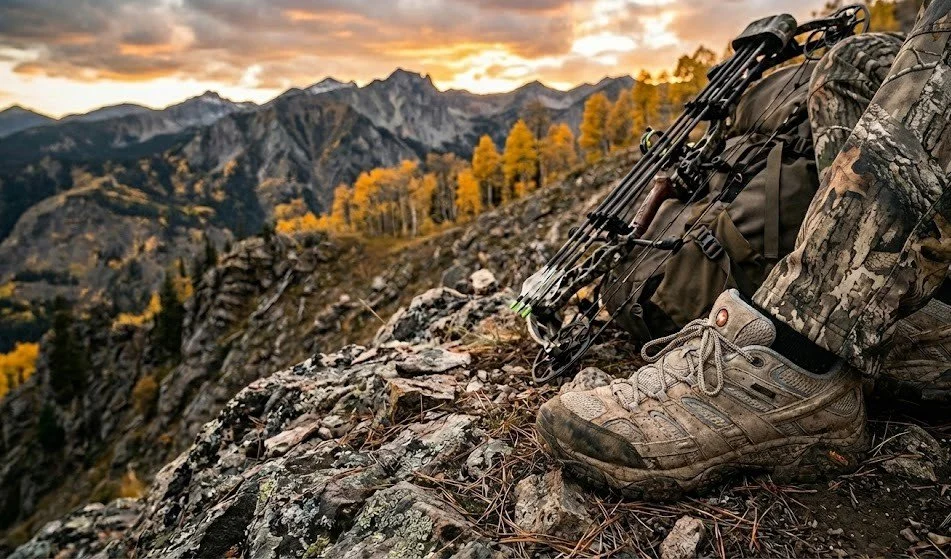
If you walk into the footwear section of any major outdoor retailer; Cabela’s, Bass Pro, or your local pro shop, you are greeted by a wall of leather and rubber that looks built for a lunar landing. The western hunting "uniform" has been standardized for decades: If you are going into the mountains, you strap two pounds of stiff, ten-inch leather to each foot.
We are told that the Rockies demand armor. We are told that without a rigid shank and a high ankle collar, the terrain will snap our ligaments like dry kindling. We buy the $500 boots because we are buying insurance against the mountain. And yes, Cross Country Trail Hikers do it in trail runners. What’s the missing link?
I subscribed to that school of thought for years. Then, I watched traditional bowhunter Clay Hayes (winner of Alone Season 8) navigate steep country in what looked like reinforced sneakers. His logic was simple: Agility is a safety feature.
So, against the advice of the marketing brochures and the skepticism of my hunting partners, I decided to run an experiment. I left the heavy mountaineering boots at home and walked into a 7-day elk hunt wearing a pair of Merrell Moab 2s.
The Experiment
This wasn’t a gentle walk on a logging road. We were hunting difficult, vertical country—the kind of drainage-hopping terrain that eats feet for breakfast. Over the course of the week, we covered more than 15 miles with significant elevation gain and loss, navigating steep switchbacks and side-hilling on loose scree.
Standing at the trailhead, looking down at my shoes, I felt under-gunned. There is a psychological security blanket that comes with lacing up a boot that feels like a ski boot. Taking that away makes you feel exposed.
But by day three, the panic had been replaced by a revelation.
The Problem with the "Foot Cast"
The traditional argument for the heavy boot is support. The theory goes that by locking the ankle in place, you prevent rolls. But biomechanically, locking the ankle comes with a cost.
When you encase your foot in a rigid boot, you effectively put it in a cast. You lose the ability to articulate your ankle. When you step on a rock or a slanted root in a stiff boot, your foot cannot flex to absorb that variance. Instead, the torque is transferred up the chain—to your knee and your hip.
In the Merrells, I found the opposite happening. When I stepped on a rock, my foot flexed around it. I wasn't fighting the terrain; I was conforming to it. My ankles didn't feel weak; they felt engaged.
The Blister Equation
The most surprising metric of the trip, however, was the condition of my skin.
Anyone who has hiked steep switchbacks in stiff boots knows the sensation of "heel lift." The boot is so rigid that it doesn't want to bend where your foot bends. As you climb, your heel rubs against the back of the boot thousands of times an hour. Friction plus heat equals blisters.
Because the light hikers were pliable, they moved with my foot. There was no leverage fighting against my heel. After seven days of hard hunting, I took my socks off to find... nothing. No hot spots. No moleskin required.
Silence is Deadly
Beyond comfort, there was a tactical advantage I hadn't anticipated: Proprioception.
In heavy boots, your feet are numb to the world. You smash through brush and step on dry sticks because you can't feel them until they break.
In the lighter shoes, the feedback loop was instant. I could feel the density of the ground. I could feel the dry branch under my arch before I put my full weight on it, allowing me to adjust mid-step. In the elk woods, where a single snap can blow a stalk, that sensitivity is worth its weight in gold.
The Verdict
Is the heavy boot dead? Not entirely.
If I am sheep hunting in jagged shale, kicking steps into a glacier, or packing a moose quarter out of a knee-deep swamp, I want the armor. I want the waterproofing and the rigidity. Tools have specific purposes.
But for the vast majority of early-to-mid-season elk hunting, the industry has oversold us on "support." We are lugging around pounds of unnecessary weight that exhaust our legs and deaden our senses, all for a sense of security that might be an illusion.
The "mountain math" holds up: One pound on your feet is equal to five pounds on your pack. By switching to the "tennis shoe" approach, I saved energy with every step. I finished the week with fresh legs and quiet stalks.
It turns out, the best way to handle the mountain isn't to fight it with a stiff sole. It's to feel it.
Thanks for reading,