The Death of Fair Chase: How Drones Are Changing the Game from Indiana to the Rockies
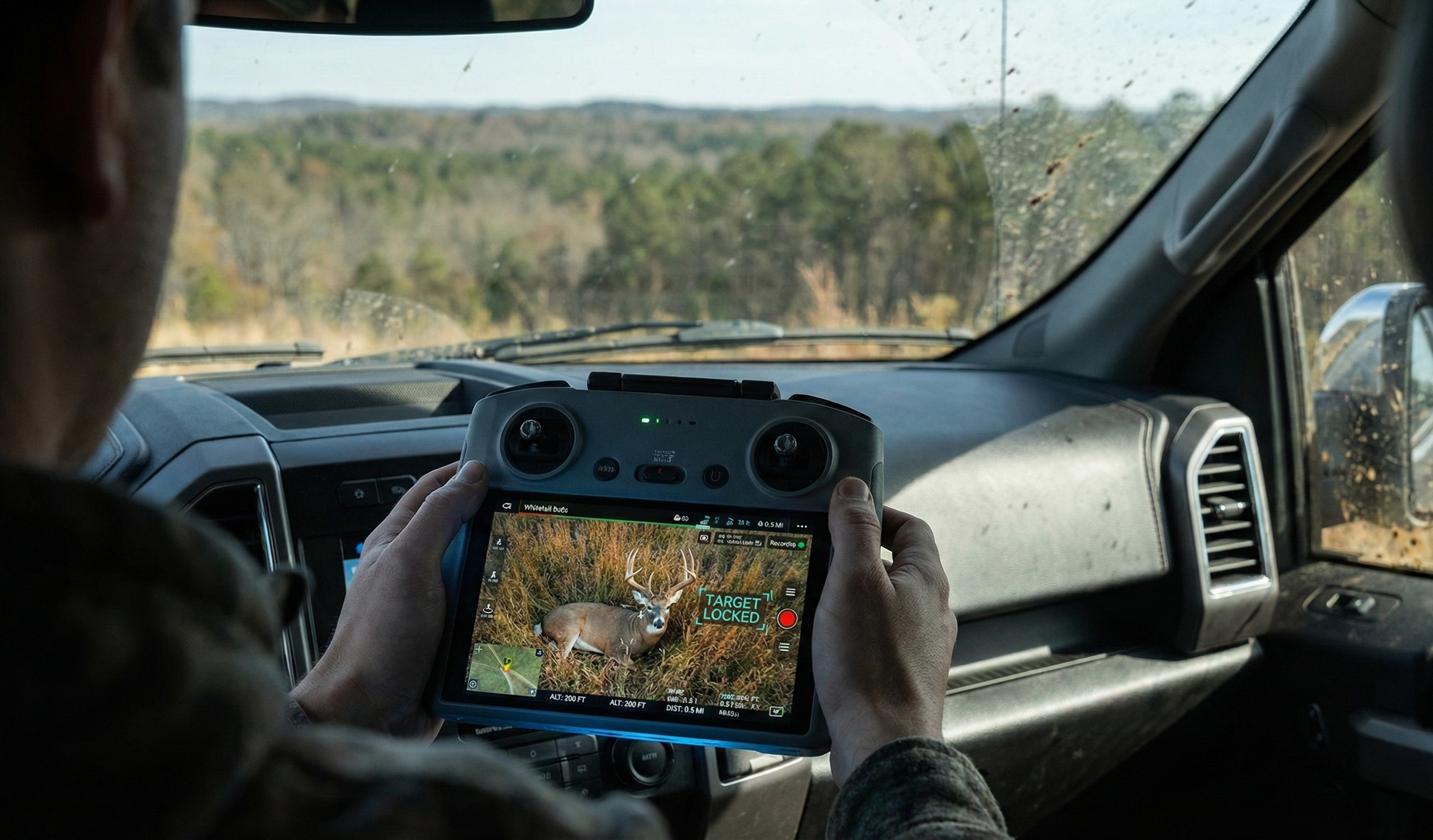
Imagine you're two miles deep on public land. It's noon. You spent the past two hours picking your way in silently, stepping over every branch, ducking every limb, so you wouldn't blow up the evening before it started. You've been in your tree for 20 minutes now. Everything's ready. The day is perfect. Wind direction is perfect.
Then you hear it.
That god-awful sound. Imagine a mosquito that went to trade school and graduated angry. You look up and there it is. A drone. Cruising right over your head.
Your hunt is over. But it's more than that. You feel violated. Like the quiet you set aside for yourself out here in the woods just had its magic ripped out.
That was me last year on public land in Kentucky. Whether that drone was being used for hunting or not, I couldn't tell you. But I know I was on public land. I know it felt wrong. And I know that gut feeling in my chest told me it could've been a poacher working the same ridge I was.
That experience stuck with me for months. Because if we let this become normal, if we let drones become just another part of hunting culture, we're not hunting anymore. We're just executing targets.
Let me be clear about something. Using drones to hunt is illegal in nearly every state in this country. Colorado, Montana, Kansas, Nebraska, South Dakota, Kentucky, New Mexico, Texas. Total bans. You cannot use a drone to scout, locate, or take wildlife. Period. A handful of states like Utah, Arizona, Nevada, and North Dakota operate on what I'd call a loophole. They treat drones like aircraft and give you a 24 to 72 hour cooling off window. Fly a drone today, you can't hunt that area for a day or two. The idea is that it separates the scouting from the kill.
But here's the risk those states are taking. A 48-hour buffer doesn't change what the technology is capable of. You can pattern a buck's entire routine in a weekend. Know exactly where he beds, where he feeds, what time he moves. Then you just wait out the clock and walk right to him. The letter of the law might be satisfied, but the spirit of fair chase? Gone.
Wyoming figured this out. They implemented a full blackout from August 1 through January 31. No aerial scouting for wildlife during that window, which covers basically every big game season that matters. Idaho's moving the same direction after a working group recommended banning all aircraft scouting for ungulates from July through December.
Indiana just gave us the clearest example of why these laws exist. District 9 conservation officers wrapped up a case that should make any ethical hunter's blood boil. Several guys used a drone to pattern a well-known local buck. Flew it over the deer daily. Took photos. Mapped its movements. Then they killed it. And because apparently that wasn't enough, they shot it over bait and trespassed to retrieve it.
Other hunters in that area had been doing it the right way for years. Learning the property. Putting in the hours. These clowns tracked that buck like they were following a package on Amazon.
Indiana's law couldn't be more clear. You can't use drones to search for, scout, locate, or detect deer during season or for 14 days before it starts. The only exception? Recovering a deer you've already legally taken. That's it.
Here's the thing about drones in the wrong hands. They don't just give an unfair advantage. They fundamentally change what hunting is. When you can spy on an animal from the air, day after day, there's no hunt left. There's just a hit.
I know the laws. I know that whoever was flying that thing over my head in Kentucky probably wasn't doing anything illegal unless they were actively using it to locate game. But that's exactly the problem. The technology exists. It's everywhere now. And even when it's not being used to cheat, it still impacts the woods. It still pressures wildlife. It still ruins the experience for hunters who are out there doing it the right way.
Kentucky Fish and Wildlife gets it. Can't use a drone to hunt, take, or harass wildlife. Period. Can't fly one to push deer toward a shooter. Can't use it to locate a live animal and then go kill it. The one gray area is drone deer recovery services, licensed pilots using thermal to find a dead deer that a hunter couldn't track. Even then, if they find it alive, they legally have to back off.
Out West, the stakes are even higher.
Pronghorn live in wide-open country. Their defense is their eyesight and the miles of nothing around them. A drone eliminates that entirely. Some guy in a truck can scout 5,000 acres in 20 minutes without ever stepping out of the cab.
Elk hunting is all about finding the herd. That's the hard part. That's the whole point. Drones skip straight past it.
What kills me is that humans have a bad habit of not understanding the impact until it's too late. We wait for symptoms instead of preventing the disease. By the time herds start declining or hunting pressure gets out of control, the damage is already done. We hope it's not irreversible. But only time tells us that.
I want to be clear about something. I'm not anti-technology. Not even close. I'm a huge fan of it when it's in the right hands and used ethically. Using a drone to actively harvest an animal? I'm against that in any way, shape, or form. But using one to recover a legally harvested deer that you couldn't track? I support that completely. And drone research for understanding species, educating new hunters, teaching terrain and habitat? That's a fantastic tool we're barely scratching the surface of.
Think about it. If a hunter truly understands his terrain based on drone surveys and research, he's not as likely to need 16 cell cameras scattered across a single trail on public land just because he can afford to. Conservation isn't just about preserving what we have. It's about consuming less. It's about pushing back on this idea that the more money you throw at the woods, the better your chances get. Good data from drone research can put a lot of common myths to bed for hunters who didn't grow up in the sport.
And here's the bigger picture. Hunters as a percentage of the population keep shrinking. Our numbers stay relatively flat, but the country keeps growing. Eventually our voice gets consumed by the voices of people who don't hunt or fish. That's reality. So when I talk about technology, I'm talking about its ability to grow and protect the ethics and resources we're supposed to be handing off to the next generation. When it starts affecting them adversely, that's where I draw the line.
All I'm asking when you read this is to consider where you draw yours. And whether it's pushing us toward the common goal we should all share. Preservation. Stewardship. Something worth passing down.
I've sat in December cold so long my feet went numb. Walked ridges in the dark just to get to a spot before first light. Spent July afternoons scouting thickets in heat that made my shirt stick to my back like a second skin. A week in the mountains and 2 days of driving to eat an out of state bow tag that would have paid my rent. That's the work. That's what makes a hunt mean something.
Technology keeps getting better. Thermal scopes. Cellular trail cams. I'm not against progress. But there's a line. And drones crossed it a long time ago.
If we want this sport to survive for the next generation, we have to respect the animal enough to give it a fighting chance. Leave the drone in the truck. Learn the woods. Hunt the way it was meant to be done.